

Frequently Asked Questions
Why do car accident laws work differently in Florida?
Florida uses a no-fault insurance system with strict deadlines. This means your own insurance pays first, and missing key time limits can cost you benefits even if you were not at fault.
How soon should I see a doctor after a crash?
As soon as possible. Florida law requires medical treatment within 14 days to qualify for Personal Injury Protection benefits, and early treatment protects both your health and your claim.
Can I still recover compensation if the accident was partly my fault?
Yes, in many cases. Florida follows a comparative fault system, but statements or actions after a crash can reduce what you’re able to recover, which is why careful handling matters.
Why shouldn’t I talk to the insurance company right away?
Insurance adjusters are trained to minimize payouts. Recorded statements or quick settlements can be used against you before you understand the full extent of your injuries.
Do all car accident cases go to trial?
No. Many cases settle, but they should be prepared as if they’re going to trial. That preparation often leads to better outcomes without ever seeing a courtroom.
How long do I have to file a personal injury claim in Florida?
In most cases, you have two years from the date of the accident to file a lawsuit. Missing this deadline permanently ends your right to seek compensation.
What makes distracted or speeding crashes harder to prove?
These behaviors are often underreported. Proving them may require deeper investigation, including crash data, witness statements, or phone records.
When should I contact a personal injury attorney?
The sooner, the better. Early guidance helps protect evidence, avoid mistakes, and ensure deadlines are met before options close.
Why Your Neighborhood Street Is Now More Deadly Than the Highway
For decades, when people thought about dangerous speeding, they pictured highways — long stretches of interstate, semis flying past at 80 miles per hour, places where speed felt like part of the deal.
But that’s not where most speeding deaths actually happen.
The data tells a different story — one that hits much closer to home. Today, the overwhelming majority of fatal speeding crashes occur on the same roads we use to grab coffee, drop off kids at school, and walk the dog.
And what we see in real cases every day confirms it.
The Numbers Don’t Lie
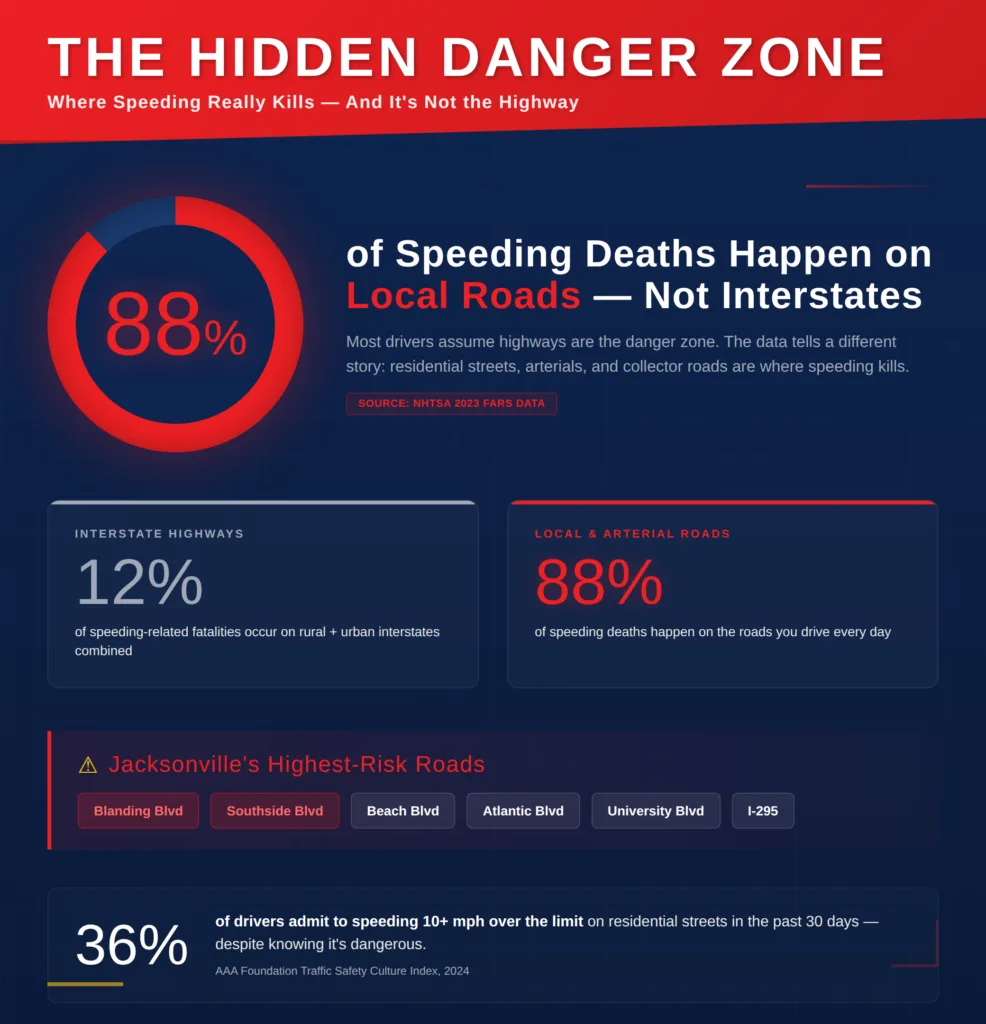
88% of Speeding Deaths Happen Off the Interstate
Here’s the statistic that should change how you think about road safety:
According to NHTSA’s 2023 Fatality Analysis Reporting System (FARS), 88% of speeding-related traffic deaths happen on non-interstate roads.
Let that sink in.
Nearly 9 out of 10 fatal speeding crashes occur on arterials, collectors, local roads, and residential streets
Only 12% happen on interstates (urban and rural combined)
The assumption that highways are the real danger zone is outdated.
The highest risk is on the roads you drive every single day.
Drivers Know It’s Dangerous — They Do It Anyway
What makes this problem worse is that speeding on local roads isn’t rare behavior.
According to the AAA Foundation’s 2024 Traffic Safety Culture Index:
36% of drivers admitted to driving 10+ mph over the speed limit on a residential street at least once in the past 30 days
That’s more than one in three drivers.
These aren’t highways. These are neighborhood streets — where kids ride bikes, joggers share the road, and families cross without expecting someone to barrel through at 45 mph in a 25 zone.
Here’s the most troubling part:
96% of drivers acknowledge that speeding is dangerous
They know.
They just do it anyway.
That gap between knowledge and behavior is where serious crashes happen.
Jacksonville’s Most Dangerous Roads
Here in Jacksonville, the national data plays out on streets we all recognize.
Based on crash data and traffic safety reports, these roads consistently rank as high-risk:
Blanding Boulevard — The Wells Road intersection alone saw 127 crashes in one year
Southside Boulevard — Especially dangerous near Baymeadows and Atlantic
Beach Boulevard at Hodges
Atlantic Boulevard at Southside
University Boulevard
I-295 — High-speed crashes and aggressive lane changes during rush hour
These aren’t obscure back roads. They’re the same routes thousands of Jacksonville residents rely on every day.
As of October 2024, Duval County had already recorded 18,000+ crashes for the year.
Jacksonville averages:
20 traffic deaths per 100,000 residents
Compared to Florida’s average of 16
And the national average of 11
Why Local Roads Are More Dangerous Than They Seem
There’s a psychology behind this.
Drivers feel comfortable on familiar streets. They’ve driven them hundreds of times. Nothing bad has happened before.
That comfort breeds complacency.
And complacency at 45 mph in a residential zone is deadly.
Local roads also have risks highways don’t:
Pedestrians and cyclists sharing space with vehicles
Intersections without protected turn signals
Parked cars blocking sightlines
Children who don’t always check before crossing
Driveways where vehicles pull out unexpectedly
Highways are engineered for speed.
Local roads are not.
When someone treats Atlantic Boulevard like I-95, the margin for error disappears.
What This Means If You’ve Been Hurt
As a personal injury firm, we don’t just study these statistics.
We see the aftermath.
Behind every number is a family whose life changed because someone decided a neighborhood road didn’t require caution — because a driver felt comfortable speeding where they shouldn’t have.
Our work often involves:
Holding reckless drivers accountable when speeding on local roads causes serious injury or wrongful death
Investigating crashes thoroughly to understand how speed, road design, and driver behavior combined to cause harm
Using federal and state data to clearly show what happened and why it mattered
These aren’t freak accidents.
They’re part of a documented national pattern — and they happen on Jacksonville streets every week.
The Bottom Line
The biggest speeding threat isn’t on a distant interstate.
It’s right outside your front door.
88% of speeding deaths happen on local roads
More than 1 in 3 drivers admit to dangerous speeding in residential areas
Jacksonville ranks among the worst U.S. cities for traffic fatalities
If you or someone you love has been injured on a Jacksonville road — whether it’s Blanding, Southside, Beach Boulevard, or a quiet neighborhood street — you deserve answers.
And you deserve someone who understands how these cases actually work.
Schedule a free case review: (904) 805 – 1500
👉 Contact us online: here